
GPS Proof-of-Presence : Stop Flat Allowance Leakage and Ghost Visits For Field Employees in 2026

Field operations in pharma, retail, CPG, fintech, and logistics still run on a broken foundation: manual logs and blind approvals for daily conveyance and flat allowances. On paper, flat-allowance reimbursement looks simple; in practice, it hides productivity leakage, ghost visits, and huge admin overhead.
Fuelshine changes this by verifying every flat allowance with GPS proof-of-presence from your team’s own smartphones.
The Problem: Flat Allowances With Zero Visibility
Under a flat-allowance reimbursement model, businesses pay field staff a fixed daily or monthly amount to cover local travel for store visits, route rides, or client meetings. It avoids per-kilometre tracking but introduces a bigger problem: you have no idea whether the work actually happened.
Common failure points:
No verified record of which outlets or sites were visited
No visibility into routes taken or time spent on-site
No audit trail when finance questions reimbursements
High exposure to “ghost visits” and overstated activity claims
Because the system is built on trust and self-reporting, operations and finance teams end up approving thousands of entries that may only partially reflect actual field activity, creating hidden productivity and budget leakage
The Administrative Bottleneck You Can’t Scale
In a typical flat-allowance setup, this is what your operations team is doing every day:
Checking daily call reports against plans and targets
Cross-validating visits in CRM or WhatsApp groups
Chasing field reps and area managers for clarifications
Approving claims manually in Excel, ERP, or email
This is slow, error-prone, and fundamentally non-scalable. The larger your field force, the more time your managers waste playing detective with incomplete data.
The result:
Delayed reimbursements that frustrate employees
Approvals that are mostly blind and subjective
Zero structured data to optimise routes and coverage
Fuelshine’s proof-of-presence engine is designed to remove this bottleneck entirely.

Fuelshine’s GPS Proof-of-Presence: How It Works
Fuelshine verifies every flat allowance rupee spent by tying it to GPS data collected from the employee’s smartphone.
At a high level, here’s what happens:
The field employee runs Fuelshine on their phone while on duty.
When they arrive at a store, branch, or partner location, the app logs GPS-based proof-of-presence with timestamp and coordinates.
Fuelshine automatically validates whether the visit matches the assigned outlet or territory plan.
The system builds a real-time log of visits, routes, and time spent at each location.
Managers see everything in a single live dashboard—no manual call reports required.
Every visit becomes a verified event, not just a line item in a spreadsheet.

100% Route Validation: Eliminate Ghost Visits and Plan Fraud
In a flat-allowance world, the biggest loss is invisible: missed visits, ghost routes, and plan deviation. Reps may claim:
They covered ten outlets but visited six
They did a “full route” but skipped low-priority stores
They travelled a long distance when they actually stayed close by
Because there is no location proof, these claims are almost impossible to challenge at scale.
Fuelshine solves this by delivering 100% route validation:
Each outlet visit is GPS-verified at the exact location
Route sequences show whether the planned path was actually followed
Time-on-site metrics highlight “drive-bys” versus real engagement
Repeated patterns of skipped outlets or shortcuts become visible immediately
Instead of debating with employees or reconciling conflicting reports, the data is objective and tamper-resistant, thanks to automatic GPS logging.

One Live Dashboard Instead of Daily Call Reports
Fuelshine replaces daily manual call reports with a single, real-time dashboard.
Managers and leadership can:
See which reps are active on the field right now
Track how many visits each manager or rep completed
Drill down into outlet-level history and coverage trends
Export audit-ready logs for finance and compliance
An approval process that previously required multiple spreadsheets, messages, and follow-ups becomes a one-click review against verified GPS data. This can cut administrative approval time by up to 95%, freeing operations teams to work on training, productivity, and growth rather than chasing paperwork.

Turning Flat Allowances Into Verified Field Touchpoints
The real win is not just cost control; it’s converting every rupee of allowance into a measurable field touchpoint.
With Fuelshine:
Every allowance is backed by GPS proof-of-presence
Every visit is tied to a real location and timestamp
Every route undertaken can be analysed for productivity and coverage gaps
Budget owners know exactly what they are paying for
Instead of “We assume they visited,” your reporting shifts to “We know who visited which outlet, when, and how often.”
This data can plug directly into:
Trade marketing ROI measurement
Distributor and outlet coverage metrics
Territory planning and route optimisation
Incentive design based on verified activity, not just self-reported numbers
Duty of Care: Your Legal Responsibility on the Road
There is another layer of risk: employer duty of care for employees using personal vehicles for work.
Under vicarious liability principles in many jurisdictions, including Canada, employers can be held legally responsible for accidents when employees drive for business purposes, even in their own cars, if it happens within the scope of their employment. If a field rep has an accident while travelling to a client meeting or store visit, regulators and courts may ask what the company did to manage that risk.
Flat allowance models are especially exposed because:
There is no structured data on trip timings or routes
There is no record of how much driving is being done for work
There is no monitoring of risky driving behaviours
Fuelshine’s real-time driver safety coaching helps close this compliance gap:
Detects unsafe patterns such as frequent harsh braking or speeding
Provides feedback to drivers to improve habits over time
Gives employers documented evidence that they are monitoring and managing on-road risk
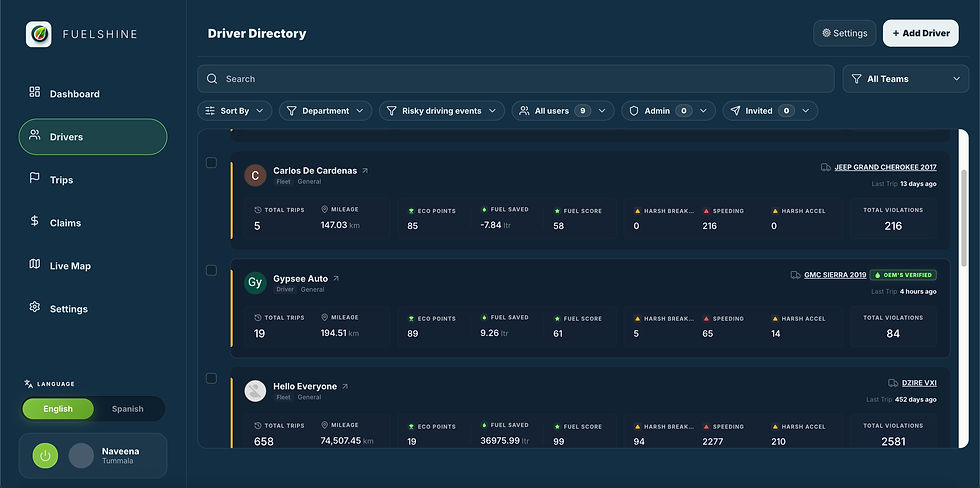
This strengthens your duty-of-care position and can support better conversations with insurers and regulators about how you manage your mobile workforce.
Leakage Reduction, Faster Approvals, Stronger Compliance
By introducing GPS-based proof-of-presence, Fuelshine transforms how flat allowances are managed, shifting spend from unverified activity to measurable productivity:
Reduce mileage and visit leakage by eliminating manual logging and unverifiable claims.
Cut administrative approval time by up to 95% by automating validation from the smartphone to your dashboard.
Ensure 100% route validation so ghost visits and route manipulation are surfaced and stopped.
Strengthen duty of care with better visibility into driving behaviour and field movement patterns.
Turn reimbursements into data that can drive sales, coverage, and operational decisions.
With Fuelshine, every rupee in your distribution and field budget translates into a verified, auditable, and optimizable field touchpoint.
Example: From Blind Spend to Verified Visits
Imagine a consumer goods company with 300 field reps on flat allowances visiting kirana stores and modern trade outlets daily.
Before Fuelshine:
300 daily reports, 300 allowances, thousands of line items
Managers sample-check a handful of reports and approve the rest on trust
Finance has no independent way to audit claims
Leadership sees only aggregate outlet numbers, not verified visit data
After Fuelshine:
Every store visit is GPS-verified and shown on a map
Non-visited but claimed outlets are instantly visible
Managers approve allowances against verified visit summaries
Finance can audit any month by drilling into GPS logs
Leadership sees true numeric coverage, not estimates, by channel and territory
The same budget now produces more reliable coverage, better compliance, and less internal friction, with far less productivity lost to unverified or missed visits.
Ready to eliminate ghost visits, shrink admin time, and make every rupee of your field budget verifiable?
Book a 20-minute Fuelshine demo and see GPS proof-of-presence in action for your own routes.


Comments