
How Mobile Telematics Solutions Like Fuelshine Are Driving Compliance for Grey Fleets

Grey fleet compliance has evolved from an operational afterthought to a critical compliance imperative for organizations whose employees drive personal vehicles for work. Mobile telematics solutions like Fuelshine are transforming how businesses manage these hidden fleets by replacing manual processes with AI-powered automation that eliminates hardware requirements while delivering audit-ready compliance, real-time safety monitoring, and measurable cost savings.
Understanding the Grey Fleet Compliance Challenge
Grey fleet refers to employee-owned vehicles used for business purposes, representing a significant blind spot for most organizations. Unlike company-owned fleets with dedicated telematics hardware, grey fleet vehicles operate without structured oversight, creating three critical risk categories: financial leakage through inflated mileage claims, legal exposure from unverified driver credentials and insurance coverage, and safety risks from invisible driving behavior. In 2026, duty-of-care obligations and stricter enforcement by tax authorities like the CRA and IRS have made grey fleet compliance non-negotiable.
Traditional approaches rely on self-reported mileage entries like "I drove about 22 km to meet a client," which are difficult to audit and easy to overstate. This creates administrative burden for finance teams who must manually cross-reference claims against calendars, estimate distances, and chase drivers for documentation—a process that takes hours per month and still leaves significant room for error and fraud.
How Mobile Telematics Transforms Grey Fleet Governance
Automatic GPS Mileage Tracking Without Hardware
Mobile telematics solutions like Fuelshine eliminate the need for expensive GPS hardware by leveraging smartphone sensors that drivers already carry. The app runs silently in the background, automatically detecting trip start and end points, capturing precise GPS routes, and measuring distance and duration with 3-10 meter accuracy. Drivers simply grant GPS permissions during setup, and the system begins logging every journey without requiring manual input or daily interaction.
This shift from self-reported to machine-verified data fundamentally changes the compliance equation. Every trip becomes structured data with timestamps, route maps, and exact distances, creating an immutable audit trail that satisfies CRA and IRS contemporaneous record requirements. Finance teams can export one-click reports showing GPS-verified routes, business purpose classifications, and reimbursements auto-calculated at current rates ($0.70/mile for IRS, $0.72/km for CRA).
AI-Powered Claim Verification and Policy Enforcement
Fuelshine's AI engine acts as an always-on compliance officer, analyzing every trip against established fleet policies before claims reach finance teams. The system automatically flags weekend driving, after-hours vehicle use, geofence violations, distance anomalies, and duplicate claims. Clean trips that match historical patterns and policy rules receive instant auto-approval, while questionable claims are escalated with full context—route map, timestamps, trip metrics, and an explanation of the specific policy violation.
This AI-native approach cuts claim review time by up to 70% and reduces mileage reimbursement costs by up to 30% by eliminating both deliberate fraud and unintentional overclaiming. Organizations can implement custom geofences around depots, client sites, or restricted zones, with the AI automatically detecting boundary crossings and unusual route patterns. Over time, the machine learning models learn typical routes and visit patterns for each driver and role, making unusual behavior immediately visible rather than buried in spreadsheet backlog.

Closing the Grey Fleet Safety Gap
Real-Time Driver Safety Scoring via Smartphone Sensors
Personal vehicles typically lack the telematics hardware installed in company fleets, leaving organizations blind to critical safety risks including speeding, harsh braking, distracted driving, and fatigue-related late-night operation. Mobile telematics closes this gap by using smartphone accelerometers, GPS, and motion sensors to capture real driving behavior without installing any equipment in employees' personal vehicles.
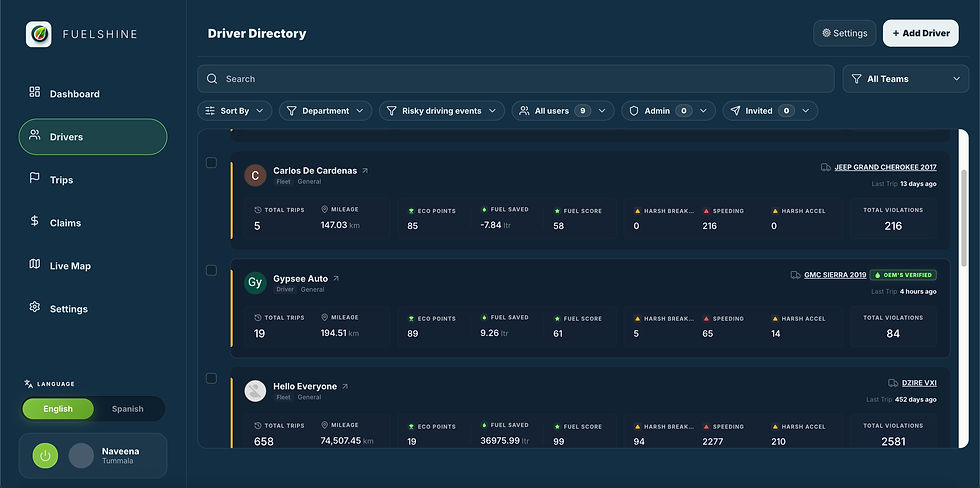
Fuelshine analyzes speed relative to posted limits, harsh braking events, rapid acceleration, stop-start patterns, time-of-day exposure, and indicators of possible phone distraction to generate dynamic safety scores (0-100) for each driver, team, and route. This data transforms grey fleets from an unmanaged liability into a continuous improvement safety program where organizations can identify emerging risk patterns before they become incidents.
Audio Coaching and Behavioral Intervention
Real-time in-app audio alerts correct harsh braking, speeding, and rapid acceleration as they happen, functioning as a personal driving coach. Organizations using Fuelshine report harsh driving events drop up to 40% with this immediate feedback loop. The platform surfaces risk patterns to managers and highlights coaching opportunities early, enabling targeted intervention for high-risk drivers without waiting for month-end reports.
Fleet operators implementing telematics-based coaching have achieved measurable results—one logistics provider reported 15% fuel cost reduction within six months through ongoing behavioral feedback. This combination of real-time correction and personalized coaching creates accountability while helping drivers develop safer, more fuel-efficient habits.

Delivering Audit-Ready Compliance Documentation
Both the CRA and IRS require businesses to maintain contemporaneous mileage records substantiating vehicle expense deductions and employee reimbursements. Each trip log must capture date, destination, business purpose, and distance driven—a requirement that manual systems struggle to meet consistently. Mobile telematics generates these records automatically in real time, creating structured compliance data without manual effort from employees or administrators.
When auditors or tax authorities request documentation, organizations can provide verified trip data with GPS coordinates, timestamps, route maps, and AI classification decisions rather than reconstructing events from memory and incomplete spreadsheets. This shifts the compliance posture from defensive documentation to proactive governance, where every decision—approve, flag, or coach—is grounded in observable, verifiable signals.

Operational Benefits Beyond Compliance Live Fleet Visibility and Coordination
Mobile telematics platforms provide operations teams with real-time visibility previously impossible for grey fleets. Fuelshine's live GPS dashboard displays every driver's location, speed, safety score, and trip status updated every 3-8 seconds on a single map. Managers can filter by team, drill down into individual trips, and export data without switching between multiple tools.
This visibility enables proactive coordination—dispatchers can identify which field reps are closest to urgent service calls, operations managers can spot drivers stuck in low-value stops versus those maximizing customer visits, and teams can reduce unnecessary trips by optimizing route planning based on actual travel patterns.

Fuel Efficiency and Cost Reduction
Mobile telematics captures trip-level fuel analytics by correlating consumption data with driving behavior, route characteristics, and vehicle performance. Organizations can identify which drivers, routes, or driving patterns generate excessive fuel waste and deliver targeted coaching to improve efficiency. Field service, construction, sales, and home healthcare teams—where fuel represents up to 40% of operating costs—can achieve up to 30% fuel savings through AI-powered driver coaching and behavior modification.
Integration with OEM platforms like Smartcar provides verified odometer readings, real-time fuel levels, tire pressure, and engine diagnostics without GPS drift, enabling predictive maintenance that saves an average of $625 per vehicle per year.

Why Hardware-Free Solutions Win for Grey Fleets
Traditional telematics requires costly GPS hardware installation, IT project scoping, and driver training—creating friction that makes grey fleet deployment impractical for many organizations. Mobile solutions eliminate these barriers entirely, enabling teams to go from signup to full operation within 24 hours without IT tickets or training sessions.
Drivers download an app, grant GPS permissions, and begin generating compliant trip data immediately. For organizations with distributed workforces, seasonal staff, or high turnover, this zero-hardware approach delivers 90% faster onboarding compared to traditional telematics while eliminating the need to install and recover devices from personal vehicles.
The ROI of AI-Native Grey Fleet Management
Organizations implementing mobile telematics solutions report compound benefits across multiple departments. Finance teams experience reduced mileage costs and faster month-end processing, operations teams gain real-time workforce visibility enabling better coordination and route optimization, and safety managers see measurably fewer harsh driving events and incident risk.
The platform replaces five or more separate fleet tools—mileage tracking apps, manual spreadsheets, policy enforcement checklists, safety monitoring systems, and fuel expense tracking—with a single integrated compliance layer. Most implementations pay for themselves within the first month through reduced fraudulent claims, lower administrative overhead, and improved fuel efficiency.
Building a Modern Grey Fleet Compliance Program
Mobile telematics solutions like Fuelshine transform grey fleet management from trust-based, estimate-driven processes into governed, data-verified compliance programs. Every trip becomes verifiable, every claim becomes auditable, and every driver receives continuous safety feedback—creating organizational confidence that reimbursements, safety standards, and regulatory obligations rest on observable facts rather than incomplete documentation.
For organizations ready to modernize how they manage the hidden fleet of employee-owned vehicles, mobile telematics represents not just helpful automation but a fundamental operating model shift where AI compliance officers work 24/7 to enforce policy, validate claims, and reduce risk without adding administrative burden to drivers or finance teams.

Take Control of Your Grey Fleet Today
Your grey fleet shouldn't be a compliance blind spot costing your organization thousands in unverified mileage claims, safety liability, and administrative overhead. Fuelshine delivers audit-ready compliance, real-time safety monitoring, and up to 30% cost reduction—all without installing a single piece of hardware.
Ready to eliminate manual mileage tracking and turn your grey fleet into a strategic advantage? Visit getfuelshine.com to start your free trial today and see how AI-powered mobile telematics can cut claim processing time by 70% while ensuring every trip meets CRA and IRS standards. Your finance team, operations managers, and drivers will thank you—and your audit trail will be ready when regulators come calling.


Comments