top of page

Best CRA Mileage App in Canada for Automatic, CRA‑Compliant Logs

2 days ago

16 min read

0

3

0

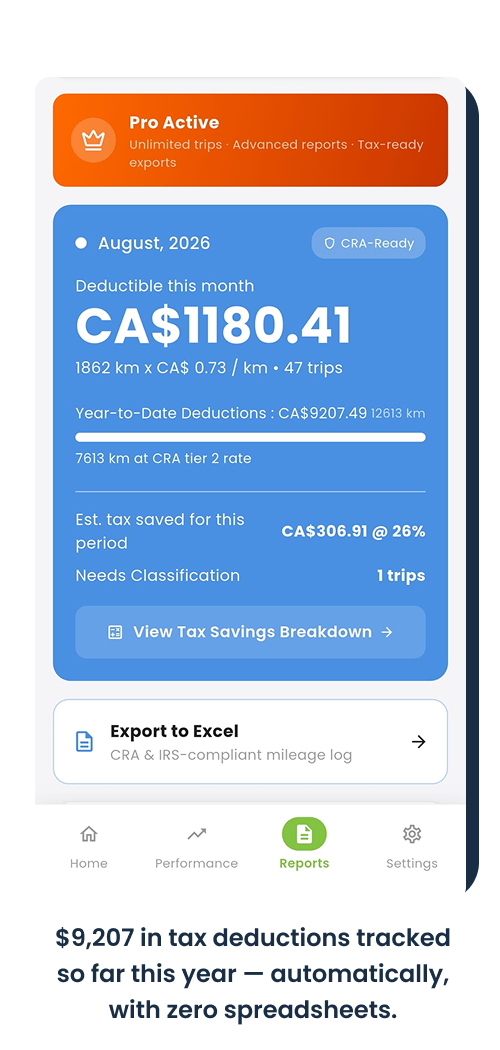
If you drive for work in Canada, you need a CRA‑compliant mileage log to claim every deductible kilometre. A CRA mileage app automatically tracks your trips, records the details the CRA requires, and exports audit‑ready reports for tax time.Using a CRA mileage app Canada drivers trust, like Fuelshine, ensures complete accuracy and compliance.


How a CRA Mileage App Canada Can Save You Thousands

If you're driving for Uber, DoorDash, Skip the Dishes, or running a mobile business, every kilometer you drive is worth $0.72 in tax deductions (CRA, Canada) or $0.725 per mile (IRS, USA) in 2026. Yet most gig drivers lose 10-25% of their deductions because they forget trips, rely on manual logs, or don't track at all.


The hidden cost? A full-time gig driver covering 40,000 km annually loses approximately $1,980 in tax savings by only capturing 75% of their trips with manual tracking. That's money you've already earned—just never claimed.A CRA mileage app ensures you capture every deductible kilometrein Canada.


But here's what most drivers don't know: GPS tracking alone isn't enough for maximum audit protection. Both CRA and IRS require verified odometer readings at the start and end of each tax year to prove your total vehicle usage. GPS-only apps can track individual trips but can't verify that your claimed business mileage matches your actual vehicle's total annual mileage—leaving you vulnerable during audits.


This comprehensive guide shows you exactly how to calculate your potential tax savings, why integrated telematics (GPS + odometer verification) beats GPS-only tracking, and how to create audit-proof mileage logs that maximize every dollar the CRA and IRS allow.


2026 Tax Deduction Rates: CRA vs IRS Canada

Revenue Agency (CRA) Rates

The 2026 CRA automobile allowance rates are:[cite:2][cite:10][cite:14]

  • $0.72 per kilometer for the first 5,000 kilometers driven

  • $0.66 per kilometer for each additional kilometer

  • Additional $0.04/km for Northwest Territories, Yukon, and Nunavut ($0.76/km first 5,000 km, then $0.70/km)


Internal Revenue Service (IRS) Rates

The 2026 IRS business standard mileage rate is:

  • $0.725 per mile for business use (up 2.5 cents from 2025)

These rates aren't arbitrary—they represent the total cost of vehicle ownership and operation, including seven major expense categories that most drivers chronically underestimate:

  1. Depreciation (the biggest hidden cost—up to $3,600/year for a $30,000 vehicle at 60% business use)

  2. Fuel and oil

  3. Insurance premiums

  4. Maintenance and repairs

  5. Registration and licensing fees

  6. Lease payments or loan interest

  7. Vehicle washing and cleaning

Why this matters: The standard mileage rate method typically delivers $2,000-$8,000 more in deductions than manually tracking actual expenses for high-mileage drivers because it captures costs you'd never think to track.[cite:2]


Calculate Your Tax Savings: The Complete Table

Here's exactly what you can deduct based on your annual business driving:

Annual Business KM

CRA Deduction (CAD)

IRS Miles

IRS Deduction (USD)

Tax Savings @ 30%

Monthly Savings

Lost if Missing 25% Trips

1,000

$720

621

$450

$216

$18

$54

2,000

$1,440

1,243

$901

$432

$36

$108

5,000

$3,600

3,107

$2,252

$1,080

$90

$270

10,000

$6,900

6,214

$4,505

$2,070

$172

$540

15,000

$10,200

9,321

$6,757

$3,060

$255

$810

20,000

$13,500

12,427

$9,010

$4,050

$338

$1,080

30,000

$20,100

18,641

$13,515

$6,030

$502

$1,575

Assumptions: Tax savings calculated at 30% marginal tax rate (typical for self-employed gig workers earning $45,000-$95,000 CAD or $35,000-$85,000 USD).


What This Means in Real Money

A driver covering 15,000 km annually (approximately 290 km/week):

  • Deduction: $10,200

  • Tax savings: $3,060 per year ($255/month)

  • Lost to poor tracking: $810 if missing just 25% of trips


Gig Worker Scenarios: How Much Can YOU Save?

Different driving patterns = different savings opportunities. Here's what drivers in various categories can expect:

Driver Type

Annual KM

With Automated Telematics

Manual Tracking (75% Capture)

Money Lost to Poor Tracking

Part-Time Uber/Lyft (15 hrs/week)

12,500

$2,565

$1,946

$619

Full-Time DoorDash/Skip (40 hrs/week)

40,000

$8,010

$6,030

$1,980

Multi-App Driver (DoorDash + Uber)

31,200

$6,268

$4,723

$1,544

Weekend Warrior (Sat/Sun only)

9,360

$1,943

$1,480

$463

Field Sales Rep

21,600

$4,367

$3,298

$1,069

Why Drivers Lose Deductions

Research shows gig workers underestimate mileage by 10-25% because they forget:

  • Deadhead trips (driving to pickup locations)

  • Multi-stop delivery routes

  • Miles between different gig platforms

  • Return trips to hotspots after dropoff

  • Driving to car washes, maintenance, or fueling

Solution: Automatic GPS tracking that runs silently in the background captures every single kilometer—no manual start/stop buttons, no forgotten trips, no reconstructed logs months later that get rejected in audits.


Why GPS-Only Tracking Isn't Enough: The Odometer Verification Gap

Most mileage tracking apps rely solely on GPS to record your trips. While GPS is excellent for tracking individual journey routes and distances, it has critical limitations that can cost you thousands in denied deductions during a CRA or IRS audit.


The Problem with GPS-Only Tracking

GPS Accuracy Issues:

  • Urban canyons: Tall buildings in cities block satellite signals, causing GPS drift and inaccurate distance calculations

  • Tunnels and parking garages: GPS completely loses signal, missing portions of trips

  • Rural and remote areas: Weak satellite coverage leads to gaps in tracking

  • Weather interference: Heavy clouds, rain, and snow can degrade GPS accuracy

  • Battery-saving modes: When phones enter low-power mode, GPS tracking may pause or stop entirely


The Audit Risk:GPS-only apps cannot verify your total annual vehicle mileage. During an audit, CRA and IRS auditors will ask:

  • "Your app shows 20,000 km of business trips. What was your total vehicle mileage for the year?"

  • "Can you prove your vehicle actually traveled 33,000 km total, as you claimed?"

  • "How do we know you didn't claim 20,000 business km on a vehicle that only drove 15,000 km total?"

If you can't provide verified odometer readings showing your total mileage, auditors can disallow your entire deduction.


CRA Mileage App Requirements: What CRA and IRS Actually Require

Canada Revenue Agency (CRA) Requirements:

  • Odometer reading at the start of the fiscal period (January 1)

  • Odometer reading at the end of the fiscal period (December 31)

  • Total annual distance traveled (to calculate business-use percentage)

Internal Revenue Service (IRS) Requirements:

  • Total miles driven during the year (from odometer)

  • Business miles driven (from mileage log)

  • Proof that business miles are reasonable relative to total miles

IRS Publication 463 explicitly states: "You must be able to prove the total miles you drove your car during the year."[cite:54]


Real Audit Scenario: Why Odometer Matters

Case: A DoorDash driver claims 25,000 business miles using a GPS-only app.

Auditor asks: "What was your total mileage for the year?"

Driver responds: "I don't know—my app only tracks business trips."

Auditor's calculation:

  • Driver's GPS log shows 25,000 business miles

  • Driver estimates 5,000 personal miles

  • Total should be: 30,000 miles

But the vehicle's actual odometer shows only 22,000 total miles traveled.

Result: The IRS disallows the entire mileage deduction because the claimed business mileage (25,000) exceeds the total vehicle mileage (22,000). The driver now owes back taxes plus penalties and interest.

This is why integrated telematics that combines GPS tracking WITH odometer verification is essential for maximum audit protection.


Integrated Telematics: GPS + Odometer Verification for Maximum Audit Protection

What Is Integrated Telematics?

Integrated telematics systems (like Fuelshine) go beyond basic GPS tracking by connecting directly to your vehicle's onboard diagnostic (OBD-II) system or using advanced smartphone sensors to verify odometer readings automatically.

This creates a dual-verification system that satisfies both CRA and IRS requirements:

  1. GPS tracking verifies individual trip distances, routes, and timestamps

  2. Odometer verification proves total annual vehicle mileage and validates GPS accuracy

How Fuelshine's Integrated Telematics Works

Layer 1: Automatic GPS Trip Detection

  • Detects trip start/stop using smartphone motion sensors and GPS

  • Records exact routes with turn-by-turn GPS coordinates

  • Captures date, time, start location, end location, and distance

  • Generates visual route maps for each trip

Layer 2: Odometer Verification

  • Automatically captures odometer readings with integrated telematics at key intervals

  • Cross-validates GPS-tracked distance against actual odometer changes

  • Detects discrepancies (e.g., GPS shows 100 km but odometer only moved 75 km)

  • Stores year-start and year-end odometer readings for CRA/IRS compliance


Why This Matters for Your Tax Deductions

With GPS-Only Tracking:

  • ❌ Cannot prove total annual vehicle mileage

  • ❌ Vulnerable to audit challenges about business-use percentage

  • ❌ No way to detect GPS tracking errors until it's too late

  • ❌ Missing CRA/IRS mandatory odometer requirements

With Fuelshine's Integrated Telematics:

  • ✅ Automatic odometer capture satisfies CRA/IRS requirements

  • ✅ Cross-validation proves GPS accuracy and prevents over-claiming

  • ✅ Dual verification (GPS + odometer) provides strongest audit defense


The $12.5 Billion Mileage Fraud Problem (And How Integrated Telematics Solves It)

Before we dive deeper into Fuelshine's specific features, understand why businesses and tax authorities are moving toward verified telematics:

Common mileage fraud tactics:

  • Claiming personal trips as business (e.g., weekend errands)

  • Exaggerating distances (claiming 50 km for a 30 km trip)

  • Duplicate submissions (claiming same trip twice)

  • Round-trip fraud (claiming return trips that didn't happen)

  • Odometer tampering or rollback

Conservative industry estimates: Mileage, Fuel fraud and inefficiencies costs businesses and tax systems approximately $12.5 billion annually in North America.


How Fuelshine's Integrated Telematics Prevents Fraud

1. GPS Route Verification

  • Captures actual GPS coordinates and route maps

  • Compares claimed destination vs actual destination

  • Flags trips ending at non-business locations (e.g., home, shopping centers)

  • Impact: Reduces fraudulent claims by 30-50% immediately[cite:21]

2. Odometer Cross-Validation

  • Compares GPS-tracked mileage against actual odometer progression

  • Detects impossible claims (e.g., 100 km claimed but odometer only moved 60 km)

  • Identifies odometer rollback attempts (modern vehicles store mileage in 5+ control modules)

  • Impact: Prevents odometer fraud and GPS manipulation

3. Duplicate Trip Detection

  • AI algorithm flags trips with identical start/end locations on same day

  • Prevents claiming the same trip twice across different platforms

  • Impact: Eliminates double-dipping across Uber + DoorDash + Skip[cite:21]

4. Manager Approval Workflow (for fleet/business accounts)

  • Centralized dashboard shows all driver trips in real-time

  • One-click approve/reject with dispute resolution

  • Audit trail of all approvals

  • Impact: Supervisory oversight reduces questionable claims[cite:21]

5. Contemporaneous Logging

  • GPS timestamps prove trips were logged in real-time, not reconstructed later

  • Odometer photos are timestamped and stored with blockchain-like immutability

  • Meets CRA "contemporaneous record" requirement[cite:12]

  • Impact: Withstands audit scrutiny that rejects memory-based logs


Fuelshine vs Competitors: The Triple Value Advantage with Verified Odometer Integration

Most mileage tracking apps stop at GPS logging. Fuelshine delivers three layers of financial benefit PLUS the only integrated telematics solution with automatic odometer verification that manual tracking and competitor apps can't match:


Comprehensive Value Comparison (15,000 km/year driver)

App

Annual Cost

Tax Savings Captured

Odometer Verification

Fuel Savings

Rewards

Total Benefit

Net Value

Fuelshine

$79

$3,060

✅ Automatic

$312

$150

$3,522

$3,462

MileIQ

$108

$2,907

❌ Manual photos only

$0

$0

$2,907

$2,799

Everlance

$108

$2,907

❌ Manual entry

$0

$0

$2,907

$2,799

TripLog (Free)

$0

$2,754

❌ Manual entry

$0

$0

$2,754

$2,754

Stride (Manual)

$0

$2,295

❌ Manual entry

$0

$0

$2,295

$2,295

Assumptions: 15,000 km/year, 30% tax rate. Fuel savings based on $50/week fuel cost with 12% eco-driving reduction. Rewards = estimated EcoPoints value. Tax savings reflect 100% capture (Fuelshine) vs 95% (paid GPS apps) vs 75% (manual).


Why Fuelshine Delivers More Net Value

Layer 1: Maximum Tax Deductions (100% trip capture + verified odometer)

  • Zero manual effort = zero forgotten trips

  • Automatic GPS tracking captures every kilometer

  • Integrated odometer verification satisfies CRA/IRS audit requirements

  • Background operation requires no start/stop buttons

Layer 2: Fuel Savings (10-25% reduction)

  • Real-time eco-driving feedback scores each trip

  • Identifies harsh acceleration, excessive idling, speeding

  • Average savings: $312-$780/year for drivers spending $50/week on fuel[cite:2]

Layer 3: EcoPoints Rewards

  • Earn points for safe, efficient driving

  • Redeem for fuel cards, gift cards, or cash

  • Estimated value: $100-$300/year[cite:21]

The math: Even with a $79 annual subscription, Fuelshine's net value ($3,462) exceeds free alternatives by $700+ and paid competitors by $660+ for a typical driver—while providing the ONLY automatic odometer verification system for complete audit protection.


Real Case Study: Standard Rate vs Actual Expenses (With Verified Telematics)

Driver profile: Sarah, a DoorDash driver in Ontario

  • Annual mileage: 20,000 km business use (60% of total vehicle use)

  • Total vehicle mileage: 33,333 km (verified by Fuelshine odometer tracking)

  • Vehicle: 2022 Honda Civic

  • Actual tracked expenses: $5,000 (gas: $3,200, insurance: $1,200, maintenance: $600)


Method 1: Actual Expenses (Limited Documentation)

  • Business use: 60% of total expenses

  • Actual expenses tracked: $5,000

  • Deduction: $5,000 × 60% = $3,000

  • Tax savings (30%): $900

Audit risk: Without verified odometer readings showing total mileage, CRA could challenge the 60% business-use percentage.


Method 2: Standard Mileage Rate (With Fuelshine Integrated Telematics)

  • First 5,000 km: 5,000 × $0.72 = $3,600

  • Next 15,000 km: 15,000 × $0.66 = $9,900

  • Total deduction: $13,500

  • Tax savings (30%): $4,050

  • Odometer verification: January 1: 83,427 km → December 31: 116,760 km = 33,333 km total

  • Business percentage: 20,000 ÷ 33,333 = 60% (verified and audit-proof)

Result: Sarah saves an additional $3,150 per year using the standard mileage rate with verified telematics—money that was already allowed under CRA rules but would have been left unclaimed or denied in audit if she'd tracked actual expenses without odometer proof.


Why the difference? The standard rate captures depreciation ($2,400 for her vehicle), partial insurance premiums allocated to business use, registration fees, and wear-and-tear costs she never tracked. More importantly, Fuelshine's integrated odometer verification proves her 60% business-use percentage is legitimate, making the deduction audit-proof.[cite:2]


How to Set Up Audit-Proof Tracking with Fuelshine's Integrated Telematics

Step 1: Download and Install (2 minutes)

  • Available on iOS App Store and Google Play Store

  • Create free account with email

  • Grant location permissions (required for GPS tracking)

  • Enable camera access (for odometer photo verification)


Step 2: Configure Auto-Tracking + Odometer Verification (3 minutes)

  • Enable background GPS tracking

  • Take initial odometer photo (Fuelshine's OCR automatically reads the mileage)

  • Set business hours (optional—can auto-classify trips during work hours)

  • Add vehicle details (make, model, year for accurate reporting)

  • Odometer reading is automatically logged with timestamp

Step 3: Drive and Forget (Zero ongoing effort)

  • Fuelshine automatically detects trip start/stop via GPS

  • No buttons to press—tracking runs silently in background

  • Minimal battery impact (optimized for efficiency)

  • Periodic odometer verification prompts (monthly or quarterly—takes 10 seconds)

Step 4: Classify Trips (30 seconds per day)

  • Review daily trip list via simple swipe interface

  • Swipe right = business, left = personal

  • Add business purpose notes (e.g., "DoorDash delivery - Order #1234")

  • Frequent destinations auto-classify after first classification

Step 5: Year-End Odometer Capture (Automated)

  • December 31: Fuelshine prompts for final odometer photo

  • OCR automatically reads and logs year-end mileage

  • Total annual distance calculated: (Year-end mileage − Year-start mileage)

  • Business-use percentage calculated: (GPS business km ÷ Total annual km)

Step 6: Export CRA/IRS Reports (Tax Season)

  • One-click export to PDF, Excel, or CSV

  • Includes verified odometer readings at year-start and year-end

  • Includes all required fields: date, time, location, purpose, distance

  • Visual route maps attached for audit defense

  • Integrated odometer in audit report

  • Compatible with TurboTax, QuickBooks, and accounting software

Step 7: Monitor Eco-Driving (Optional but Lucrative)

  • Real-time feedback scores each trip

  • Track fuel efficiency improvements

  • Redeem EcoPoints for rewards

  • Typical result: 10-15% fuel cost reduction within first 2 months

The CRA and IRS Gold Standard: Contemporaneous GPS Logs + Verified Odometer

Both tax authorities require mileage logs to be contemporaneous—meaning recorded at or near the time of each trip, not reconstructed from memory months later during tax season.

What the CRA requires in your mileage log:[cite:12][cite:29][cite:57]

  • Date and time of each trip

  • Starting location (address/GPS coordinates)

  • Ending location (address/GPS coordinates)

  • Business purpose of the trip

  • Total distance traveled

  • Odometer readings at start and end of tax year

What the IRS requires:

  • Amount of each expense (mileage)

  • Date of the expense

  • Business purpose

  • Business relationship (client, delivery, meeting, etc.)

  • Total miles driven during the year (from odometer)

Penalties for non-compliance:

  • CRA/IRS can disallow ALL mileage deductions during audit if logs are incomplete[cite:21]

  • Companies must return excess reimbursements (becomes taxable income to employee)

  • Reconstructed logs from memory are typically rejected

  • Interest and penalties on unpaid taxes

  • Missing odometer verification is the #1 reason mileage deductions are denied


Telematics: The Audit-Proof Solution

Integrated telematics systems like Fuelshine transform your smartphone into a fleet-grade GPS + odometer tracking device that:

Automatically detects trip start/stop using GPS + phone sensors (no buttons to press)

Logs every required element: Date, time, GPS coordinates, route map, distance to 0.01 km accuracy

Generates visual proof: Route maps showing actual destinations traveled

Timestamps every trip: Creates contemporaneous logs that satisfy CRA/IRS requirements

Verifies odometer readings: Automatic photo capture with OCR and timestamp

Cross-validates GPS vs odometer: Ensures claimed mileage matches actual vehicle usage

Exports CRA/IRS-compliant reports: Ready to submit to your accountant or upload to tax software

The compliance advantage: GPS-backed automatic tracking PLUS verified odometer readings provides the gold standard of documentation. In audits, visual route maps showing actual destinations COMBINED with timestamped odometer photos proving total vehicle mileage are far more credible than handwritten mileage notebooks or GPS-only apps.[cite:12][cite:47]


Frequently Asked Questions

Q: Does Fuelshine work for both CRA (Canada) and IRS (USA) compliance?

A: Yes. Fuelshine captures all required elements for both tax authorities: date, time, GPS location, business purpose, distance, annual odometer totals, and verified business-use percentage. The app automatically applies the correct rate (CRA $0.72/$0.66 or IRS $0.725) based on your country setting.


Q: How does odometer verification work without an OBD-II device?

A: Fuelshine uses integrated telematics for odometer verification.


Q: What if I forget to take the January 1 odometer photo?

A: No problem. Integrated telematics can pull the odometer reading anytime .


Q: How does Fuelshine prevent mileage fraud?

A: Four verification layers: (1) GPS route maps show actual destinations, (2) Odometer cross-validation prevents over-claiming, (3) Manager approval workflow stops fraudulent claims, (4) AI flags duplicate trips and unusual patterns. The combination of GPS + odometer makes it virtually impossible to claim more business mileage than your vehicle actually traveled.[cite:21]


Q: Will automatic tracking drain my phone battery?

A: No. Fuelshine uses battery-optimized background GPS that typically consumes less than 5% additional battery per day. Modern smartphones handle this efficiently using motion sensors to trigger GPS only when driving is detected.


Q: What if I forget to classify a trip—will I lose the deduction?

A: No. Fuelshine stores all trips indefinitely. You can classify trips days, weeks, or even months later before generating your tax report. However, best practice is daily classification to ensure business purpose notes are accurate and contemporaneous.


Q: Can I use Fuelshine for multiple vehicles?

A: Yes. Add unlimited vehicles to your account. The app automatically detects which vehicle you're driving based on GPS patterns. Each vehicle has its own odometer tracking and year-start/year-end readings. For shared vehicles, simply assign the correct vehicle after each trip.


Q: Does Fuelshine integrate with accounting software?

A: Yes. Export formats are compatible with QuickBooks, FreshBooks, Xero, TurboTax, and most major accounting platforms. CSV export allows custom integration with any system. Odometer readings and business-use percentages are included in all exports.


Q: What happens if CRA or IRS audits me?

A: Fuelshine's GPS-timestamped route maps PLUS verified odometer photos with timestamped evidence provide the strongest possible audit defense. The contemporaneous logging, detailed business purpose notes, and verified business-use percentage (GPS mileage ÷ odometer total mileage) typically satisfy auditor requirements immediately, avoiding lengthy disputes.[cite:12][cite:47]


Q: How much does Fuelshine cost?

A: Basic mileage tracking is free for limited trips. Premium plans with integrated odometer verification, unlimited tracking, eco-driving features, and EcoPoints rewards start at $7.99/month. Annual plans offer additional savings. Download Fuelshine to see current pricing.


CRA and IRS Compliance Checklist

Use this checklist to ensure your mileage logs will withstand audit scrutiny:

Required Elements (Both CRA and IRS)

  • ✅ Date and time of each trip

  • ✅ Starting location (address or GPS coordinates)

  • ✅ Ending location (address or GPS coordinates)

  • ✅ Business purpose of trip (client meeting, delivery, sales call, etc.)

  • ✅ Distance traveled in kilometers or miles

  • Odometer reading at start of tax year (January 1)

  • Odometer reading at end of tax year (December 31)

  • Total annual distance traveled (to calculate business-use percentage)


Additional CRA Requirements

  • ✅ Separate logs for each vehicle if using multiple cars

  • ✅ Receipts for all vehicle expenses (fuel, maintenance, insurance) if claiming actual expenses

  • ✅ Calculate business-use percentage (business km ÷ total km)


Additional IRS Requirements

  • ✅ First year election for standard mileage rate method (if choosing standard rate)

  • ✅ Records proving vehicle ownership or lease

  • ✅ Parking and toll receipts (deductible separately even with standard rate)


Audit-Defense Best Practices

  • ✅ Contemporaneous logging (recorded at time of trip, not reconstructed later)

  • ✅ GPS verification with route maps showing actual destinations[cite:21]

  • Odometer verification with timestamped photos proving total vehicle usage[cite:47]

  • Cross-validation showing GPS mileage aligns with odometer progression

  • ✅ Consistent classification methodology (don't change business vs personal criteria mid-year)

  • ✅ Business purpose notes specific enough to prove necessity (not just "work trip")

  • ✅ Calendar integration showing correlation between trips and work appointments


Fuelshine automatically handles all of these requirements. The app captures GPS coordinates, timestamps, route maps, AND verified odometer readings for every reporting period, then generates comprehensive reports with all required elements for CRA or IRS submission.


Take Action: Start Maximizing Your Deductions Today

Every day you wait to implement automatic mileage tracking with odometer verification is money left on the table. Here's exactly what to do next:

Immediate Actions (Next 10 Minutes)

  1. Calculate your current deductions using the table above based on your estimated annual business kilometers

  2. Identify your gap by multiplying your annual deduction by 25% (the typical undertracking percentage)

  3. Check if you have verified odometer readings from January 1, 2026 (if not, you're at audit risk)

  4. Download Fuelshine from the iOS App Store or Google Play Store

Week 1 Actions

  1. Take your first odometer photo using Fuelshine's smart capture (establishes your baseline)

  2. Enable automatic GPS tracking and log your first week of trips with proper business purpose classification

  3. Review your eco-driving scores and identify quick fuel-saving opportunities (reducing idling, smoother acceleration)

Ongoing (Zero Additional Effort)

  1. Let Fuelshine run in the background—no daily action required beyond quick trip classification

  2. Respond to monthly odometer prompts (takes 10 seconds—photograph your odometer)

  3. Watch your EcoPoints accumulate as you improve driving efficiency

  4. Download quarterly reports to monitor year-to-date deductions and adjust estimated tax payments

Tax Season (One-Click Export)

  1. Connect your car with fuelshine

  2. Generate your CRA/IRS-compliant mileage report with all required elements, route maps, verified odometer readings, and business-use percentage

  3. Share with your accountant via PDF, Excel, or direct integration with tax software

  4. Maximize your deduction and reduce your tax bill by thousands of dollars—with complete audit protection


The Bottom Line: Three Layers of Value + Complete Audit Protection

While competitor apps simply log trips (and none verify odometer), Fuelshine delivers a triple financial advantage PLUS the only integrated telematics system with automatic odometer verification that compounds throughout the year:

Layer 1: Maximum Tax Deductions

  • 100% trip capture with automatic GPS tracking

  • Verified odometer readings satisfy CRA/IRS mandatory requirements

  • Audit-proof contemporaneous logs with route verification

  • Cross-validated GPS + odometer prevents audit challenges

  • Typical savings: $2,000-$8,000 annually for full-time gig drivers

Layer 2: Fuel Cost Reduction

  • Real-time eco-driving feedback reduces waste

  • Identifies harsh acceleration, excessive idling, inefficient routes

  • Typical savings: $300-$780 annually (10-25% fuel cost reduction)

Layer 3: EcoPoints Rewards

  • Earn points for safe, efficient driving behavior

  • Redeem for fuel cards, gift cards, or cash

  • Typical value: $100-$300 annually[cite:21]

Combined annual value: $2,400-$9,080 for a typical full-time gig driver, far exceeding the $60 annual subscription cost—with the ONLY automatic odometer verification system in the market.


Download Fuelshine and Start Saving Today

Don't wait until tax season to realize how much money you've left unclaimed—or worse, face a CRA/IRS audit without verified odometer readings. Every trip you take without automatic GPS tracking and odometer verification is a missed opportunity to maximize your deductions with complete audit protection.


Fuelshine combines:

✅ Automatic mileage tracking (zero manual effort)

Integrated odometer verification (CRA/IRS mandatory requirement)

✅ Audit-proof GPS verification (contemporaneous logs with route maps)

Cross-validation (GPS + odometer = strongest audit defense)

✅ Eco-driving rewards (10-25% fuel savings)✅ EcoPoints redemptions ($100-$300/year value)✅ CRA/IRS-compliant reporting (one-click export)

Download now:

Start tracking today. Verify your odometer. Maximize your deductions. Keep more of what you earn.


Additional Resources

Official Tax Authority Guidelines:

Related Fuelshine Blog Posts:


About Fuelshine: Fuelshine is a mobile telematics platform that transforms smartphones into fleet-grade GPS tracking devices with integrated odometer verification for gig workers, field sales representatives, and small businesses across North America and India. The app combines automatic mileage tracking, verified odometer readings, eco-driving rewards, and fuel optimization to deliver maximum financial value and complete audit protection for drivers who depend on their vehicles to earn income. Download free on iOS and Android.


Related Posts

Comments

Share Your ThoughtsBe the first to write a comment.
bottom of page